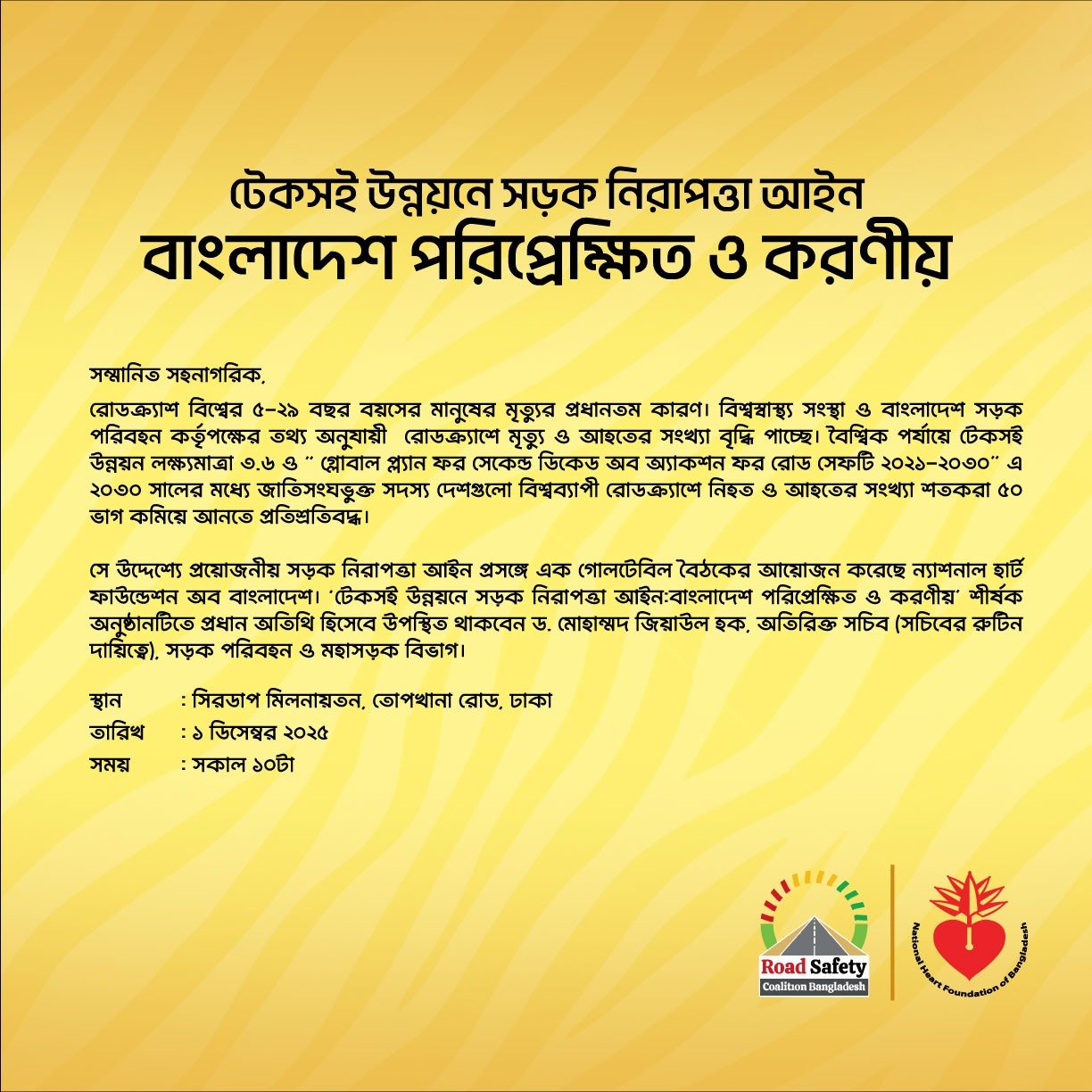
A comprehensive and effective Road Safety Act must be enacted immediately if Bangladesh is to cut road-crash-related deaths and injuries by half by 2030. Speakers made this call at a roundtable organized by the National Heart Foundation of Bangladesh in Dhaka on Monday (1 December 2025), titled “Road Safety Law for Sustainable Development: Bangladesh Context and Way Forward.”
Speakers noted that the World Health Organization identifies road crashes as a preventable noncommunicable disease. Under SDG 3.6, the global target is to reduce road-crash fatalities by 50 percent by 2030—an ambition that requires decisive action from Bangladesh without delay.
The keynote presentation was delivered by Mohammad Wali Noman, Manager of the Road Safety Injury and Prevention Program at the National Heart Foundation of Bangladesh. He highlighted that more than 5,000 people die annually in road crashes, with many more injured. According to BRTA and research organizations, nearly 70 percent of these crashes result from speeding and lack of safety measures.
He emphasized that adopting the “Safe System Approach”—safe roads, safe speeds, safe road users and safe vehicles—outlined in the Global Plan for the Second Decade of Action can significantly reduce casualties, as demonstrated by many countries.
Citing a 2023 study by CIPRB and the National Heart Foundation, he added that most road-crash victims first seek care at primary health centers, which have limited emergency capacity. Around 16.2 percent of hospital beds are occupied by such patients, each requiring approximately 16 days of treatment and spending around BDT 31,683 for medicines, transport, food and accommodation—placing long-term pressure on the health system.
In the open discussion, youth participants stated that road crashes have become one of the leading causes of death among young people and stressed the urgent need for a dedicated law and its strict enforcement.
Speaking as chief guest, BRTA Chairman Abu Momtaz Sad Uddin Ahmed said road safety is not the responsibility of any single institution. A coordinated effort among researchers, doctors, engineers, transport owners and workers, and local authorities is essential to reduce casualties by 50 percent. For this, a new and standalone Road Safety Act is necessary. He noted that individuals aged 5–29 are most vulnerable, even though they are the future drivers of the nation’s economy.
Dhaka Divisional Commissioner Sharf Uddin Ahmed Choudhury, presiding over the event, said road-crash deaths and disabilities are putting immense strain on the health system and pushing families into financial hardship. He noted that the Road Transport Act 2018 and its 2022 regulations lack clear provisions for post-crash response, preventing timely care. A comprehensive Road Safety Act is now indispensable.
The welcome remarks were delivered by M. Khalid Mahmud, Manager of BRAC’s Road Safety Program. Other attendees included Additional Secretary (Estate) of the Road Transport and Highways Division Nikhil Kumar Das; GHAI Country Coordinator Dr. Md. Shariful Alam; Shitanshu Biswas, Director of Road Safety; Dr. Nurul Islam, Deputy Director of the Directorate General of Health Services; Highway Police Deputy Inspector General Habibur Rahman; Dr. Mahfuzur Rahman, Director of the Road Safety Program, National Heart Foundation; Senior Communication Officer Abu Jafor; members of the Bangladesh Road Safety Coalition, and many others.